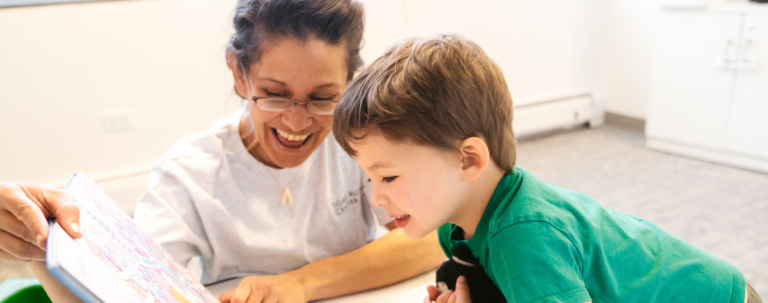
At Soar, all the evidence-based specialties for autism care are under one roof, including occupational therapy. This video demonstrates how we incorporate OT into our whole-child care model of autism care.
Discover ways to enrich your child’s life with our New Parent Kit, a comprehensive guide designed to support parents and caregivers navigating autism care.
Thank you for signing up, your Parent kit should begin downloading shortly. Otherwise click here to try again.
What are the main treatment options for children with autism?
Conceptually, there are 3 broad categories of treatment modalities used to support children with autism: 1) behavior and communication approaches, 2) medications, and 3) complementary and alternative medicines, including dietary approaches. What is needed for each individual child will vary and should be based on a consultation with an expert provider in autism.
Why is early identification important?
A wide body of scientific research supports that early detection of speech delays and early intervention is beneficial to young children. Indeed, the CDC has a campaign called Learn the Signs, Act Early to encourage early detection of potential delays in young children.
What are the main signs of autism?
It’s important to note that the initial signs of autism in children can vary significantly for each child. Different children will often show different signs — some children may show many signs and other children may show few signs. The time course can also vary by child, with some children showing signs at a very young age (first few months of life), others showing signs after 1-2 years of life, and still other children appearing to have a normal development for their first couple of years and then appearing to regress and lose abilities they used to have (such as losing communication skills). And it is also possible to have some of the symptoms of autism but not have autism spectrum disorder. Because of this complexity, a specialized health care provider is needed to establish a diagnosis of autism.
What causes autism?
The underlying biology in the brains of people with autism is not fully understood by researchers and scientists, and a single underlying process in the brain has not been found. The general consensus among scientists is that genetic factors cause changes in brain structure and connectivity, which in turn affects socialization and communication skills and causes the characteristic behaviors in people with autism. A significant amount of research time and funding is ongoing to better understand the biology of autism. We have additional details on the biology of autism and links to research in our new parent kit.
What is Autism Spectrum Disorder (ASD)?
There are a wide range of causes of a speech delay. Some children may have only a delay in language, for which many children “catch up” as they get older and undergo therapy. Other children may have a more general developmental condition where speech delay is one sign of a broader condition, such as autism. Still other children could have other issues such as a hearing impairment. If you notice speech delay in your toddler, you should speak to your pediatrician or a specialized health care provider about your concerns.
FAQs
What is the Soar autism learning center?
Our autism learning center is Soar’s library of autism resources: articles and short informational videos for parents and caregivers of children with autism. Topics range from a starting point for parents and caregivers to overviews of autism, neurodiversity, therapy, finding a provider, and resources for local families. You can filter by format (articles or videos) and by topic, and most pieces take just a few minutes to read or watch.
What autism resources for parents are in the Learning Center?
The Learning Center gathers practical autism resources for parents in one place. You will find guides on using health insurance for autism therapy, finding an autism therapy provider, handling concerns with a current provider, and common situations families face, plus a decoder for autism terms. You can read the articles and watch the videos without signing up.
Where can I find a list of common autism acronyms?
Our Common Abbreviations in Autism Care article decodes the autism acronyms you will hear about treatment, providers, and credentials. It covers terms like ABA (Applied Behavior Analysis), BCBA (Board Certified Behavior Analyst), RBT (Registered Behavior Technician), SLP (speech-language pathologist), OT (occupational therapist), and AAC (augmentative and alternative communication). It also explains Early Intervention terms, such as Colorado’s CCBs (Community-Centered Boards) and the IFSP (Individualized Family Service Plan).
Does the Learning Center have autism videos?
Yes. Choose “Informational videos” in the filter to see only autism videos. They explain parts of the Early Start Denver Model (ESDM) and how Soar’s multidisciplinary team works together. Some articles include a video too, such as Providers on an Autism Therapy Team, which gives a snapshot of each provider’s role on your child’s care team.
What is Soar’s New Parent Kit?
The New Parent Kit is an autism guide for parents and caregivers who are navigating autism care. It shares ways to enrich your child’s life, along with more detail on the biology of autism, and links to research. You can find it in the Parent kit section of this page.
Are there autism support groups for parents in Colorado?
Yes. Our list of local parent support groups in Colorado brings together autism support groups for parents and families. It includes Autism Society of Colorado meetups and support groups, Parent to Parent of Colorado (P2P-CO), the Denver Autism Parents and Autism in Colorado Facebook groups, and Rocky Mountain Sibs for brothers and sisters. It also lists a group based outside Colorado. If you know of a group that is missing, let us know so we can add it.
What Denver autism resources are in the Learning Center?