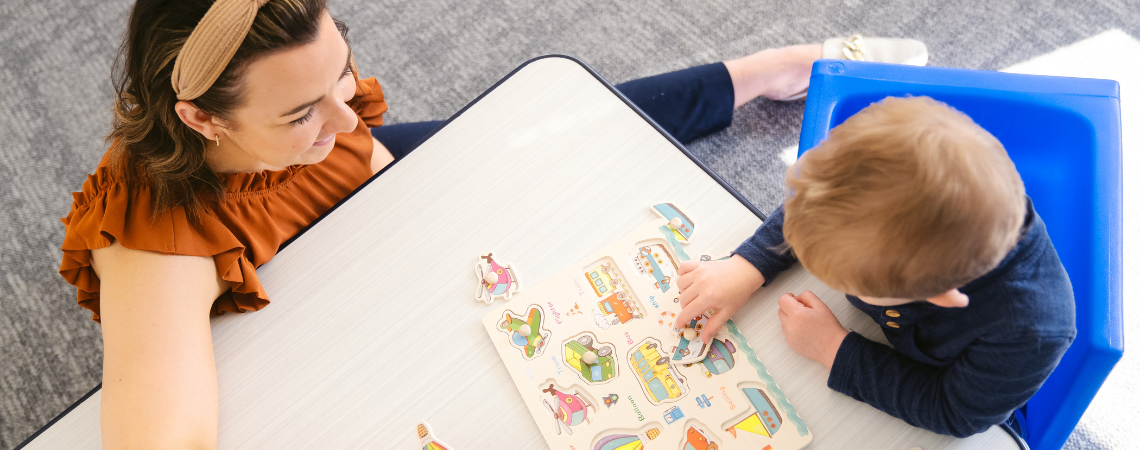

Integrating learning moments into your child’s daily home life does not need to look like a lesson or come with an involved setup. Learning at home can be infused into normal daily moments like bath time, mealtime, or within play activities your child enjoys. A familiar song, a tower of blocks, or a few minutes with crayons can create meaningful chances to communicate, take turns, solve a problem, and connect with you.
At Soar Autism Center, our approach to autism therapy for young children uses naturalistic, play-based Applied Behavior Analysis (ABA) therapy built on the Early Start Denver Model (ESDM). In practice, that means learning happens through the routines and play already in your child’s day, with your relationship with your child staying at the center.
You can use the same idea at home without turning playtime into something that feels like a drill. Start with something your child already likes. Join in, make the activity shared, and add one small opportunity to learn.
How the Early Start Denver Model supports learning through play
We call these shared learning moments joint activity routines because they are a back-and-forth activity between your child and another person. They are integrated into ways children naturally learn, and are how you’d expect to play with any child in your life. However, play moments may differ slightly when playing with a young child with autism, as they may have their own approach to play structure or form of attention. That doesn’t affect the type of play, but may affect how the play happens. The activity may last 30 seconds or several minutes depending on how long your child is engaged. What matters is that both of you have a role.
A block tower becomes a joint learning moment when you take turns adding pieces. A song becomes one when you pause and leave room for your child to move, gesture, make a sound, or add a word. Coloring becomes joint learning when you choose colors, make marks, and react to each other’s ideas.
A simple approach to setting up a joint learning activity
- Join in. Notice what has your child’s attention, then get close enough to participate without taking over.
- Share in the activity. Create an easy back-and-forth pattern. You might take turns, copy an action, or do one part together.
- Expand the play. Add one small idea, such as a new sound, word, movement, object, or playful problem to solve.
- Wait and watch. Give your child their own time to respond or take a next step. Your child may respond with a look, movement, gesture, sound, word, or another form of communication.
- Clean up together. End the activity when your child loses interest. A simple cue such as ‘all done’ or setting up a visual timer to count down to putting materials away gives your child a cue that the play has ended.
Your child does not need to respond in a certain way. Avoid rapid questions or repeated prompts. Model language by speaking naturally, leave time for a response, and recognize every communication attempt. If your child changes the activity, you can follow their idea and keep the interaction going.
Six play learning activities to try at home
1. Color together
Coloring gives you an easy way to share materials, imitate actions, build fine motor skills, and add language to a calm activity. The goal is not necessarily to stay inside the lines. Scribbles, dots, big circles, and pretend play with the pages all count.
To infuse a learning moment, sit beside your child and choose a page together. If your child colors a car, you might say, ‘You’re coloring the car,’ or add a sound such as ‘Vroom.’ If your child says ‘car,’ you can expand it slightly with ‘fast car’ or ‘red car.’ Keep your words connected to what your child is doing.
Follow their ideas and interests, join in where you can naturally. Label what you notice, write down words your child uses, and read those words back. If the coloring sheet becomes a road for toy cars or a house for small figures, join that play. Our head of Occupational Therapy, Kate Brough, shares, “For children who are newer to coloring, try using short, thick crayons or markers. These will be easier for your child to manipulate as they develop hand strength and fine motor control. Egg-shaped crayons or pip-squeak markers are perfect for learning how to scribble.”
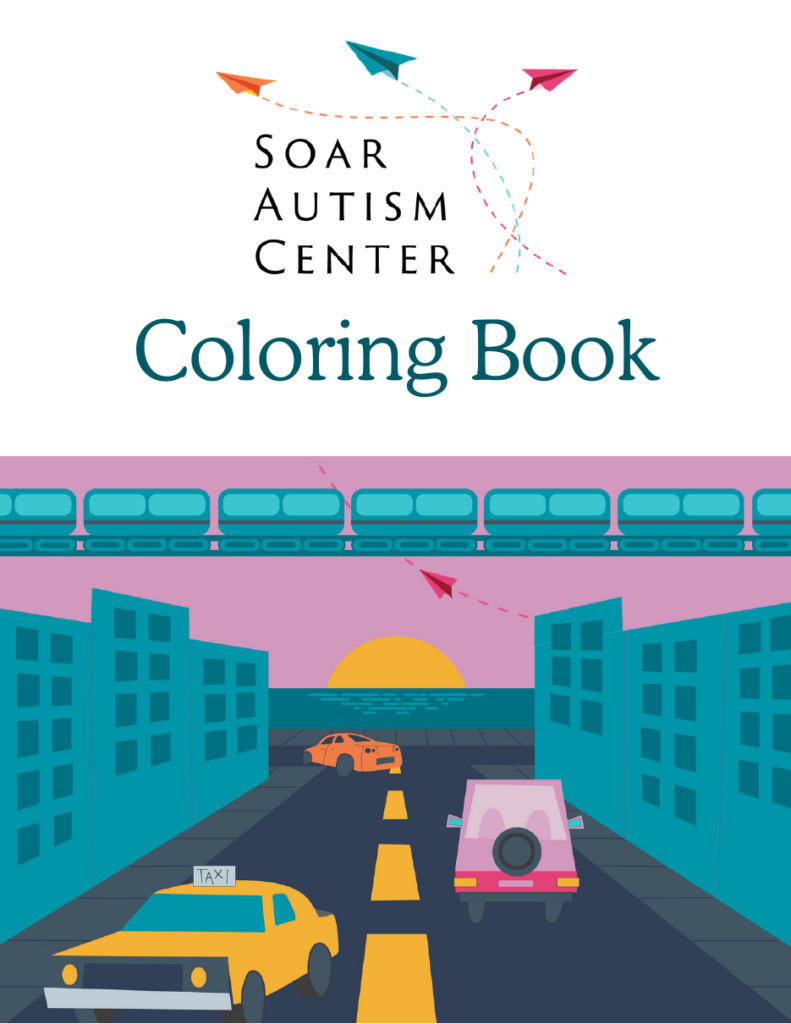
For more learning ideas to infuse into coloring together, click on and print out our coloring book below; each page has learning ideas and prompts to use at home.
2. Build with blocks or vehicles
Take turns adding one block, pushing one car, or building one part of a road. Copy your child’s action first. Then add a small new action, such as a tunnel, a crash, or a passenger. Use short, useful words like ‘up,’ ‘go,’ ‘stop,’ ‘more,’ and ‘my turn.’
Each of these play moments can also be a learning moment: practicing imitation, turn-taking, action words, early problem-solving, and flexible play.
3. Blow bubbles
Many children love bubbles. Along with the whimsy they bring, they also hold an expected pattern: open the bottle, blow, watch, and pop.
Infuse additional learning moments by adding action words such as ‘open,’ ‘blow,’ ‘pop,’ and ‘again.’ Practice gestures, shared attention, anticipation, and simple turn-taking.
4. Share a snack
Snack time can either be a predictable routine (which sometimes it needs to be on those busy days!), but it can also be an opportunity to encourage learning and trying new foods. We often hear that mealtimes and eating can be a difficult time for autism families, and making them feel more like play can eventually lead to more engagement. Give your child a role that fits their skills, such as carrying a napkin, stirring, pouring with help, or placing food on a plate. Allow them choices of 1-2 foods to eat along with something new to try. You can also infuse additional choices and motor skills work by allowing them to choose a novelty utensil to try at snack time, like mini tongs or skewering items onto a popsicle stick.
In addition to food exposure, these moments can practice choices, requesting, sequencing, fine motor skills, and words such as ‘in,’ ‘more,’ ‘open,’ and ‘all done.’ Choose foods and tools that are safe for your child, and follow any feeding guidance from their care team.
5. Start a dance party
Choose a song your child enjoys and pair it with the same movements each time. Pause at a familiar part. Your child may fill the pause with a movement, sound, smile, gesture, or words. Add new motions or dance moves as the routine feels familiar. For example, you can use a farm song while pointing to animals in the coloring book above or make up a marching song for the dinosaur page.
This activity can help your kiddo practice imitation, anticipation, movement, and communication.
6. Read a book together
Let your child turn pages, point, act out a picture, or skip ahead. Comment on what catches their attention instead of asking them to name each object. Copy a sound or movement they make, then begin to introduce new ones.
Reading together is a useful time to practice shared attention, gestures, sounds, words, and pretend play. If your child tells part of the story, write down their words and read them back.
Follow your child’s lead
A useful learning moment begins with connection. Notice what your child enjoys, then make yourself part of that experience. Some days your child may want to participate in longer back-and-forth games. Other days, joining for one turn is enough.
Watch for signs that your child wants a break, wants help, or wants to change the activity. Responding to those messages teaches your child that communication works. It also keeps play safe, respectful, and enjoyable for everyone.
If your child receives autism therapy, their care team can help you adapt these ideas to their interests, communication style, motor skills, and goals.
To learn more about Soar’s naturalistic, play-based ESDM therapy and how it may support your child’s learning goals, schedule a call with our team