
Written by Abby Wischkaemper, PhD, Head of Psychological Services and Licensed Psychologist at Soar Autism Center
You know your child better than anyone. If something about the way they play, communicate, or connect has you wondering if they’re developing differently than peers, you are already doing the right thing by looking into it.
This guide walks through some of the signs of autism spectrum disorder (ASD) age by age, from 6 months to 24 months, the signs that can appear any time from 12 months to age 5, then a closer look at ages 3 to 5 years. It gives you a checklist to bring to your pediatrician and explains what happens next if you want a formal diagnosis.
As you read, it’s important to remember that one behavior on its own, or a few delayed milestones, does not mean your child has autism. What matters to clinicians when assessing for autism is how a combination of unique behaviors and delays may appear within specific age ranges and if these patterns have been occurring across developmental stages.
How autism unfolds: what researchers currently understand
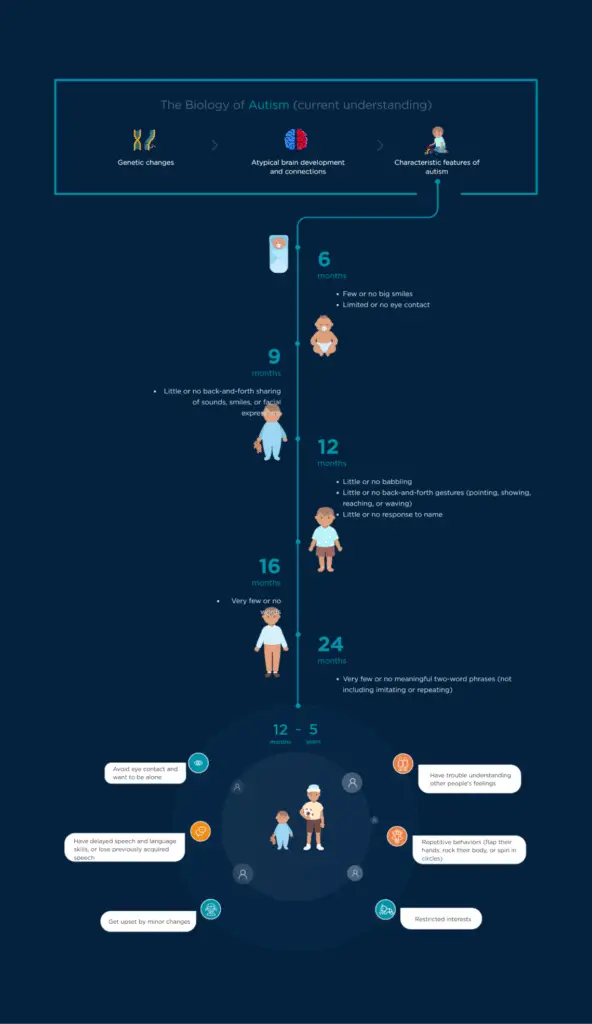
Although ongoing research continues to explore the causes and varied presentations of autism, evidence consistently highlights genetic factors that unfold in the following ways:
STEP 1 Genetic changes Autism begins with differences in a child’s genes beginning very soon after conception. Research is ongoing, and no single gene explains it. |
↓
STEP 2 Atypical brain development and connections Those genetic differences shape how the brain grows and how its regions connect with each other. |
↓
STEP 3 Observable characteristic features of autism Over time, those differences in development show up in how a child communicates, socially connects, plays, and responds to their environment. |
If you want to learn more about the science behind an autism diagnosis, Biology and causes of autism covers what is known so far and what is still being studied.
When diagnosing autism, clinicians are looking into two main areas of behaviors and how those behaviors differ or align with developmental norms of children within similar age ranges.
- Social communication and connection. How your child shares attention, uses gestures and words, and responds to the people around them. This might look like rarely pointing to show you something, not answering to their name, only making requests to get needs met without engaging in social comments, or playing alongside others without joining in.
- Rigid or repeated behaviors, routines, and sensory differences. How your child plays, handles change, and reacts to everyday sensory information. This might look like lining up toys the same way every time, playing with a limited variety of toys in the same way every time, a big reaction when a routine or activity changes, seeking intense movements such as spinning or jumping, or covering their ears at everyday sounds.
Behaviors and signs can show up in a variety of ways for each individual, but need to be present in each domain for diagnostic criteria to be met. Clinicians look for differences in social communication and connection and in repeated behaviors, routines, or sensory responses, showing up over time and impacting functioning in more than one setting. A difference in only one area, like a speech delay on its own, can have other explanations. That’s why the signs below are grouped under these two areas.
Every child with autism is different. Some children show many signs early. Others show only a few, or the signs become clearer as they get older. Some children develop as expected for a while and then lose words or skills they had. All of these are worth a conversation with your pediatrician, and a loss of words or skills is worth a call soon.
Signs of autism by age
Because each child develops at their own pace, ages should be used as general guidelines rather than strict milestones. While individual growth varies, typical developmental ranges exist for when these skills usually emerge. For example, first words can develop between the ages of 11 months and 15 months. We recommend beginning with the age range closest to your child, but also reviewing earlier categories, as behaviors from younger age brackets remain relevant. If you observe that your child is progressing differently compared to peers of a similar age, it is recommended to discuss these observations with your pediatrician.
By 6 months
Babies this age usually make sounds, smile back at you, and/or study your face. The earliest signs of a developmental difference are often observed in these first connection points. You might notice:
- Few or no big smiles or other warm, joyful expressions.
- Rarely looks at your face or shares a look with you.
By 9 months
Around now, babies typically trade sounds and smiles with you like a conversation without words. A sign to watch for:
- Little or no back-and-forth, imitation, or sharing of sounds, smiles, or facial expressions.
By 12 months
By their first birthday, most children’s actions center around babbling, attempting some familiar words, using gestures (waving, holding their arms up to be held), and responding to your voice. Potential developmental ASD signs at this age include:
- Little or no babbling.
- Little or no back-and-forth gestures, such as pointing, showing items, reaching, or waving.
- Little or no response to their name, even when they clearly hear you.
- Note: a “response” at this age could look like turning their head toward you or looking at you.
By 16 months
Single words usually start to show up around the first birthday and build from there. The use of gestures to communicate also increases (pointing with their index finger, blowing kisses, nodding their head to indicate yes or no). The signs at this age can include:
- Very few or no words or use of gestures.
- Lack of eye contact when attempting to communicate by giving items to others or trying to get caregivers to look at something they are interested in.
This is also the age when the Modified Checklist for Autism in Toddlers, Revised (M-CHAT-R) becomes useful. It is a free screener for children between 16 and 30 months. More on that below.
By 24 months
Around age 2, children start putting words together on their own. ASD signs we may look for at this age include:
- Very few or no meaningful two-word phrases.
- “Meaningful” means your child combines two words on their own to ask, tell, or comment, like “more juice” or “go outside.”
- Few attempts to gain caregivers’ attention or have them join their play or activities
Ages 3 to 5
Differences in development can become clearer at these ages as play skills and communication start to become more complex, and children typically begin to have increased interest in, and interaction with, peers. A child with autism may:
- Have persistent delays in language use, such as continuing to speak in single words or short phrases only to get their needs met or repeat phrases rather than responding.
- Show little pretend play, such as feeding a doll, making toy cars “drive,” or pretending to be a superhero or a doctor.
- Find it hard to join other children in play, take turns, or follow the rules of a group game or activity.
- Not sing, dance, or perform for trusted adults the way many preschoolers love to.
- Have trouble understanding other people’s feelings. They may not notice when someone is upset, may not respond to it, or may respond inappropriately by laughing or becoming significantly distressed themselves when they hear someone crying.
Between from 12 months to age 5
Some signs are not tied to a particular developmental age. They can show up at any point in the toddler and preschool years, become clearer as your child gets older, or be a loss of a previously gained skill. A child with autism may present consistent patterns of behavior in the two developmental realms we pay attention to.
Social communication and connection
- Seem more comfortable playing alone. They may rarely look to share a moment with you, or choose playing by themselves over playing with you or other children.
- Have delayed speech and language skills, or lose speech they had before. A child may only use words to label things/concepts that they see or stop using words they previously used to say.
- Repeat words or phrases. Echoing what you just said or a line from a show instead of using words to ask/answer questions or comment. Clinicians call this echolalia.
Rigid and repeated behaviors, routines, and sensory differences
- Repeated movements. Flapping their hands, rocking their body, or spinning in circles, especially when excited or upset.
- Get upset by minor changes. A different cup, a new route to daycare, or a change in the order of bedtime can bring a big reaction. Need routines to stay exactly the same and have big reactions to transitions, like leaving the playground.
- Have restricted interests. A strong focus on a few topics or objects and little interest in much else.
- React strongly to the senses. Covering their ears at everyday sounds, refusing clothes with tags or seams, gagging on certain food textures, or the opposite: seeking out spinning, crashing, and strong pressure.
- Line up toys or play with parts of toys. Spinning the wheels of a car instead of driving it, or arranging blocks in the same row every time and getting upset when it changes.
Other concerns worth mentioning to your pediatrician include:
- Trouble falling or staying asleep
- Eating only a few foods
- Emotional outbursts that last longer than a few minutes (10-15+ minutes) or include aggressive behaviors such as hitting or throwing items
- Being very active and hard to settle, or very quiet and easy to overlook
- Strong fears of everyday things, or no fear in situations that call for it, like running toward a street
While these aren’t signs of autism on their own, they can often be secondary concerns that co-occur with signs of autism.
A checklist to bring to your pediatrician
Print this or keep it in your notes app. Check the ones that sound like your child most of the time, not just on a hard day.
Early connection (6 to 12 months)
☐ Few or no big smiles
☐ Rarely looks at your face or shares a look with you
☐ Little or no back-and-forth sharing of sounds, smiles, or facial expressions
☐ Little or no babbling
☐ Little or no pointing, showing, reaching, or waving
☐ Little or no response to their name
Words (16 to 24 months)
☐ Very few or no words by 16 months (expected to have at least 50 words)
☐ Very few or no meaningful two-word phrases by 24 months (example: “Want ball” or “Big dog”)
Ages 3 to 5
☐ Shows little-to-no pretend play
☐ Finds it hard to join other children or take turns
☐ Does not notice when someone is hurt or upset
☐ Talks in scripts from books or shows or repeats your phrases in the same way each time
Any time from 12 months to age 5
☐ Seems more comfortable playing alone
☐ Has trouble labeling or responding to other people’s feelings
☐ Delayed speech and language, or lost speech they had before
☐ Repeats movements like hand flapping, rocking, or spinning
☐ Gets upset by minor changes
☐ Has restricted interests (example: highly prefers 1-2 toys despite having options)
☐ Has unusual reactions to, or seeks out, sounds, textures, lights, smells, or tastes
☐ Repeats words or phrases instead of using words to ask or comment
☐ Lines up toys or plays with parts of toys
☐ Trouble sleeping, a very short list of foods, or very big fears (or no fear or awareness of danger))
Try to keep a record
It helps to remember or write down when you first noticed signs and how they might be changing over time. Example: I first noticed some of these signs when my child was about ______ months or years old.
It also helps to jot down two or three real examples and, if you can, take a short video on your phone. Clinicians learn a lot from seeing a moment as it actually happens at home.
What to do next
The first thing to remember is that whether your child eventually is diagnosed as having autism or not, they are still the same child you had before. Having more details about their physical and mental health simply allows you to advocate and understand them better. Before anything, remind yourself of a few things:
- A speech delay alone is not autism. Plenty of children who talk late do not have autism. Delayed speech is worth checking on, but it is one piece of a bigger picture.
- You did not cause this. Autism is not the result of parenting or anything you did or did not do. You are already helping by paying attention and seeking answers.
- Some of these signs can overlap with other things. Hearing loss, a language delay, anxiety, and attention differences can all look like autism without enough context. That is one reason a full evaluation matters.
- Signs are not a verdict. Only a trained clinician can diagnose autism, and a diagnosis describes support needs, not your child’s potential.
If you still believe there is a need to take action, most families follow a path that includes the following steps:
1. Talk with your pediatrician
Bring the checklist and your examples. The American Academy of Pediatrics recommends that every child be screened for autism at their 18-month and 24-month well visits, so ask your pediatrician what that screening showed and whether they recommend a developmental evaluation. If your child is not responding to their name or is late to talk, ask for a hearing test too, since hearing is one of the first things clinicians rule out. If you want to skip ahead, you can also reach out to Soar directly. You do not need a referral to talk with our care team and request a diagnostic evaluation.
2. Take the free M-CHAT-R screener
If your child is between 16 and 30 months, the M-CHAT-R is a free 20-question screener. You answer it yourself in a few minutes. It does not diagnose anything, but it can help put some anxiety to rest or help you decide whether to ask for a full evaluation. Take the free M-CHAT-R screener here.
3. Get a diagnostic evaluation if you want a clearer answer
An autism evaluation is a closer look at how your child communicates, plays, and connects with others, led by a clinician trained to diagnose autism and the variety of ways it can show up in a person. It can give you a clear answer and a better picture of how your child learns best. If your child is diagnosed, it can also open doors to support such as developmental therapies (e.g., ABA therapy, occupational therapy, speech/language therapy), community support waivers/financial assistance, and services through your school district.
At Soar, a licensed psychologist leads the evaluation. Your child’s evaluation begins with a consultation with the psychologist to review their developmental history and any key concerns. Following this, your child will attend an in-person assessment at a Soar center. During this visit, a trained clinician will engage them in structured play and social activities to observe their interactions and responses. Afterwards, you will schedule an appointment with the psychologist to go over the results and plan the best path forward for your family. A complete, detailed written report will also be provided within a few weeks to support your next steps.
Learn more about diagnostic evaluations at Soar.
4. Learn what support can look like
Sharing the diagnosis is entirely your decision. Key reasons you might choose to share it include accessing therapy services, offering documentation and context to your child’s school, keeping your pediatrician informed, and securing financial assistance or community-based support. You are in control of the next steps
If your child receives a diagnosis, accessing early support helps young children build communication, play, and connection skills during the years when the brain is growing fastest. At Soar, that support is naturalistic, play-based Applied Behavior Analysis (ABA) therapy built on the Early Start Denver Model (ESDM), with speech therapy, occupational therapy, and parent and caregiver coaching under one roof.
Every state also runs a free early intervention program for children under 3, and your pediatrician can refer you. Families can use it on its own or alongside therapy at Soar.
To go deeper, read Getting an autism diagnosis for my child and A starting point for parents and caregivers.
Trust what you notice
Noticing signs like these can bring up a lot at once. Paying attention is already a way of caring for your child. Whether or not your child has autism, the next step is the same: write down what you see, talk with your pediatrician, and keep asking questions until the answers make sense to you. Your child is still the same kid they were yesterday, and you don’t have to figure out what comes next on your own.
FAQs
What are the first signs of autism in a baby or toddler?
The earliest signs are about connection. By 6 months, a baby may show few big smiles and rarely share a look with you. By 9 months, they may share few sounds, smiles, or facial expressions back and forth with you. By 12 months, they may babble very little, rarely point, show, reach, or wave, and respond to their name only some of the time. Every child is different, and one sign on its own is not a diagnosis.
What is the difference between the signs and the symptoms of autism?
The two words are often used for the same things. In medicine, a sign is something another person can see, like a toddler who rarely points, and a symptom is something a person experiences and describes. Young children can’t always describe what they experience, so most of what parents and clinicians notice are signs. You’ll still see “ASD symptoms” used for the same features of autism spectrum disorder.
Can a child be diagnosed with autism at 18 months?
Yes. Soar evaluates young children starting at 18 months using tools like the ADOS-2. If your child is younger and you have concerns, talk with your pediatrician now rather than waiting.
Is delayed speech always a sign of autism?
No. Plenty of children who talk late do not have autism. Clinicians look at speech alongside gestures, play, rigid behavior patterns, and how a child responds to others. A speech delay is worth checking, and a speech therapist or pediatrician can help you sort out what may be going on.
What is the M-CHAT-R, and is it free?
The Modified Checklist for Autism in Toddlers, Revised (M-CHAT-R) is a free screening questionnaire for children ages 16 to 30 months. Parents complete it themselves or at their well-visits with the pediatrician. A higher score means a full evaluation is a good idea. A low score means autism is less likely, but you should still raise any concerns with your pediatrician. It is a screener, not a diagnosis.
Can a child show some of these signs and not have autism?
Yes. Many children show one or two of these signs at some point and do not have autism. Hearing loss, a language delay, anxiety, and attention differences can all look similar early on. Clinicians look for a consistent pattern across communication, play, and behavior over time, which is why a full evaluation matters more than any single sign.
Can the signs of autism be missed early on?
Yes. Some children talk early, do well with letters and numbers, or copy what other children do, and their differences do not become clear until social demands increase, often when they enter a pre-school or school setting. If you are noticing the signs of autism, it is worth bringing up even if your child appears to be meeting other milestones.
What is the difference between an autism screening and a diagnosis?
A screening, like the M-CHAT-R or the questions your pediatrician asks at the 18-month and 24-month visits, is a short checklist that tells you whether a closer look is a good idea. A diagnosis comes from a comprehensive evaluation by a licensed clinician using multiple sources of information and more thorough assessment tools (e.g., ADOS-2, CARS-2). A positive screen does not mean your child has autism. It means an evaluation may be the right next step.
What happens during an autism evaluation at Soar?
A licensed psychologist leads a comprehensive intake conversation and additional assessments are included to provide a detailed look at your child’s development. One of the measures used is the ADOS-2. The Autism Diagnostic Observation Schedule, Second Edition (ADOS-2) is a set of play-based activities to observe your child’s social engagement, play, behavior patterns, and communication. For most toddlers and young children, it feels like comfortable playtime rather than a formal assessment. Some parts of the process happen virtually, and other parts, such as the ADOS-2, happen at a Soar center. You will schedule an appointment within one week of your in-person appointment to review the results of the evaluation and discuss next steps. A written report is provided to you within a few weeks.
Do I need a referral to get my child evaluated for autism?
You do not need a referral to talk with our care team. Some insurance plans ask for one before they cover an evaluation, and our intake team will check your benefits and let you know before anything is scheduled.
Does an autism diagnosis mean my child has to start therapy?
No. The diagnosis belongs to your family, and you decide what comes next. Many families use it to start early intervention therapy, and others take it to their school district or another provider. If you choose therapy at Soar, the next step is a Multidisciplinary Assessment and a plan built for your child.
What should I do if my child lost words or skills they had?
Reach out to your pediatrician or to Soar soon. Losing skills a child once had is a sign clinicians take seriously, and an evaluation can help explain what is happening. Acting early gives your child support sooner.
Talk with our care team. If anything in this guide sounds like your child, we are glad to talk it through, with no pressure and no obligation. Make an appointment to schedule a call with our intake team.