
Overview of autism therapy
2 min read

Joint Activity Routines

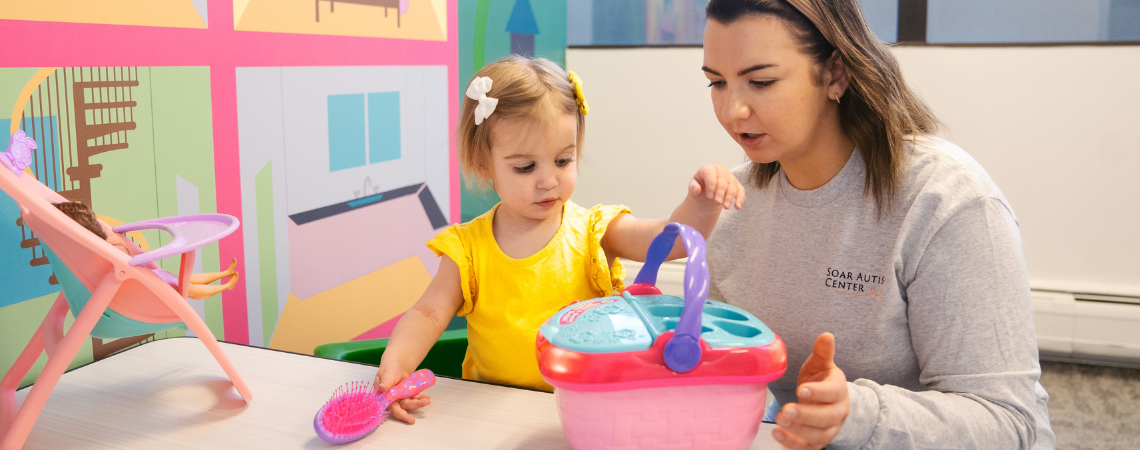
little girl and clinician playing
Published on

22 Apr 2022

One of the key features of the Early Start Denver Model (ESDM) for autism therapy is learning through play and everyday routines.

Joint activity routines or “JARs” are used as the core learning tool in the ESDM model of autism therapy, which Soar emphasizes.

What are Joint Activity Routines?

  • JARs are activities involving two or more people, where shared engagement, communication, and play are the primary focus.
  • The therapist and child build the activity together through “shared control” where the adult and child take turns leading the activity. This is like how a parent and child might interact during everyday life.
  • Note: This does not mean that the child is always “in charge” of every interaction and activity. The therapist and child share control of activity selection, pace, style, and variations.
  • Learning opportunities are embedded within the JAR, preserving child motivation while teaching skills effectively. These embedded learning opportunities can create additional naturally occurring learning opportunities/activities throughout the day.


Click here to see a video that demonstrates a sensory social routine, which is a type of JAR.
Share this post
Overview of autism therapy
RESOURCES

Autism learning center

Gain a deeper understanding of autism and our innovative therapeutic approaches. 

A therapist and a young child play blocks together
Overview of autism therapy
8 min read
As the leading evidence-based autism therapy, ESDM has been shown to improve language skills, cognition, social skills, adaptive skills, and behavior in children with autism.
Overview of the Early Start Denver Model (ESDM)
If you have heard or read much about ABA you know there is a lot of information out there, and it can be difficult to sort through. This article helps to explain how Applied Behavior Analysis has evolved as a treatment for Autism and how we apply the ABA science to best serve our clients here at Soar.
The Evolution of ABA: a Short History of Applied Behavior Analysis
A toddler plays with cups while adult watches
Overview of autism
10 min read
Learn about the signs of autism at 6 months, 9 months, 12 months, 16 months, and 24 months. This infographic also touches on our scientific current understanding of the biology and causes of autism spectrum disorder.
The signs of autism in young children, age by age