
Reviewed by Will Martin, MEd, BCBA, Head of ESDM Implementation at Soar Autism Center
If your child’s care team has recommended applied behavior analysis (ABA), you may have questions about what it is, where it came from, how it may help, and how it is delivered. Looking into the evolution and forms of ABA is a great place to start. ABA today looks very different from how it began, and knowing its history can help you understand the care your child receives and the questions worth asking any provider.
What is applied behavior analysis?
To define applied behavior analysis simply: ABA is the science of learning and behavior, used to help individuals build essential skills, communicate, and navigate their world. It uses what we know about how people learn, like noticing what motivates someone and building on success, to teach skills in small, achievable steps.
ABA is a broad science, not a single method. It can be practiced in very different ways, from structured, adult-led discrete trial training (DTT) to naturalistic developmental behavioral interventions (NDBIs) like the Early Start Denver Model (ESDM). Over the past several decades, the way it is used with young children has often shifted from structured, table-based teaching to include additional methods of naturalistic, play-based approaches that focus on learning through interaction with others.
A short history of ABA
The history of ABA spans more than a century of research, from early laboratory studies to today’s collaborative, play-based therapy. This timeline covers a brief applied behavior analysis history to understand how the practice has evolved as new learnings were uncovered.
When | What happened | Impact on today’s field |
Early 1900s | Behavioral researchers like Ivan Pavlov, Edward Thorndike, and John Watson studied how animals and people learn from their surroundings | Laid the scientific groundwork for behavior science. These were lab studies and not applied to social behaviors, and today’s therapy doesn’t use the same specific methods. |
1938 | B.F. Skinner described operant conditioning: behavior that leads to a good outcome tends to happen again | Introduced reinforcement, still a core learning principle today |
1960s | Researchers began using behavior science to help individuals with developmental differences, including autism | Moved the science from the lab into everyday life |
1968 | The Journal of Applied Behavior Analysis launched, and a paper in its first volume defined seven core dimensions of ABA | Gave the field a shared definition and standards |
1970s and 1980s | Ivar Lovaas and others used highly structured teaching, often at a table, called discrete trial training (DTT). It became the most common way ABA was used with children with autism | Showed that children could build new skills with consistent teaching. While a small sample initially showed skills could be readily generalized, some early programs used harsh responses to challenging behavior. Upon further study, it was found these skills didn’t always carry over to everyday life |
1970s and 1980s | Researchers developed more naturalistic methods, like incidental teaching and what became pivotal response treatment | Began bringing learning into play and everyday moments |
1981 | Sally Rogers began developing the Denver Model, a developmental-behavioral approach for young children | The starting point for the Early Start Denver Model |
1980s through 2000s | Sally Rogers, Geraldine Dawson, Robert and Lynn Koegel, and others developed models that merge behavior learning with developmental science, now called naturalistic developmental behavioral interventions (NDBIs) | Learning follows the child’s motivation, with more caregiver involvement and a focus on relationships |
1998 | The Behavior Analyst Certification Board (BACB) was founded | Created national credentials for behavior analysts, like the Board Certified Behavior Analyst (BCBA) |
2010 | The Early Start Denver Model (ESDM) manual was published, along with a major study of ESDM for toddlers | Combined ABA with developmental science for children as young as 1 |
2014 | The BACB created the Registered Behavior Technician (RBT) credential | Set training and supervision standards for frontline therapists |
2015 | Leading researchers named the family of developmental behavioral approaches, including ESDM | Recognized naturalistic teaching as an evidence-based path |
2022 | The BACB’s updated ethics code took effect | Strengthened standards for compassionate, family-centered care |
The science behind ABA
ABA grew out of the science of behaviorism, the study of how what happens around us shapes what we do. In the 1930s, B.F. Skinner showed that behavior followed by something rewarding tends to happen again. This idea, called reinforcement, is still at the center of ABA today.
In 1968, three researchers, Donald Baer, Montrose Wolf, and Todd Risley, wrote a paper that defined ABA as its own field. They said it should be applied to real-life needs, measurable, based on data, clearly described, grounded in science, effective, and lasting across settings. Those seven dimensions still guide ABA practice.
Early ABA therapy for autism
In the 1960s and 1970s, researchers, including Ivar Lovaas, began using ABA with children with autism. Much of this early work used discrete trial training (DTT), a structured style of teaching where skills are broken into small steps and practiced one at a time, often at a table.
This work showed that young children could build new skills with consistent, intensive teaching, and it helped make ABA one of the most studied therapies for autism. Some early methods however, also used punishment and were applied in ways that the field has since rejected. Today’s ABA is guided by an ethics code that puts a person’s dignity, self, safety, and well-being first.
The shift to naturalistic, play-based ABA
At the same time, other researchers asked a different question: what if learning happened during play and everyday moments, where children would actually use their new skills?
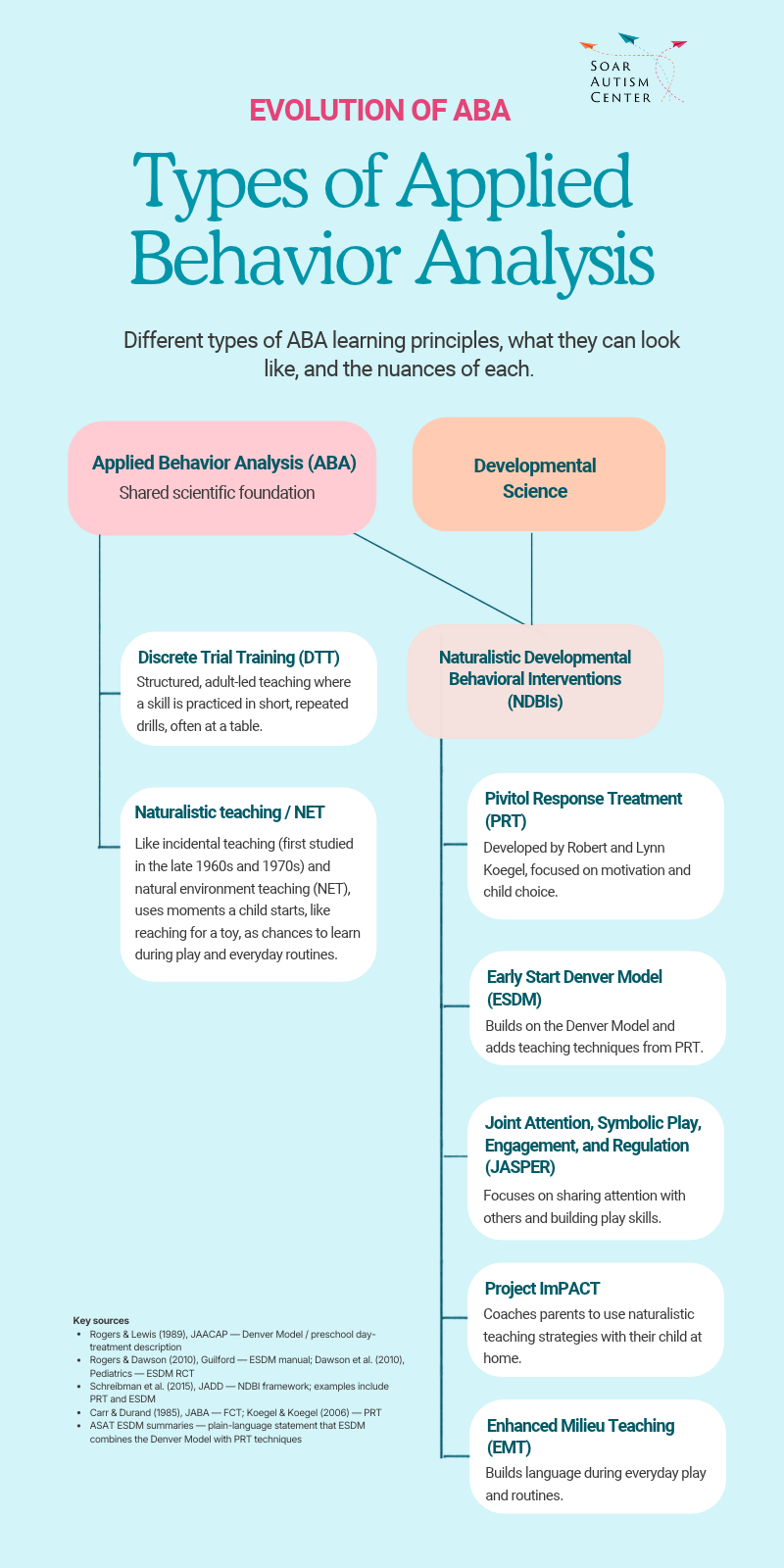
Today, ABA includes two broad groups of approaches. The first includes:
- Discrete trial training (DTT) is structured, adult-led teaching where a skill is practiced in short, repeated drills, often at a table.
- Naturalistic teaching, like incidental teaching (first studied in the late 1960s and 1970s) and natural environment teaching (NET), uses moments a child starts, like reaching for a toy, as chances to learn during play and everyday routines.
The second group is Naturalistic Developmental Behavioral Interventions (NDBIs). These approaches combine ABA with developmental science and teach through play and everyday routines. Some, like ESDM, cover many areas of development, and others focus on one area, like communication or play:
- Pivotal response treatment (PRT), developed by Robert and Lynn Koegel, focused on motivation and child choice.
- The Denver Model, started by Sally Rogers in 1981, brought developmental science and play into early intervention for young children. It’s the historical starting point for ESDM.
- The Early Start Denver Model (ESDM) builds on the Denver Model and adds teaching techniques from PRT. You can read more about ESDM below.
- JASPER (Joint Attention, Symbolic Play, Engagement, and Regulation) focuses on sharing attention with others and building play skills.
- Project ImPACT coaches parents to use naturalistic teaching strategies with their child at home.
- Enhanced Milieu Teaching (EMT) builds language during everyday play and routines.
The ESDM’s roots go back to the Denver Model. Sally Rogers and Geraldine Dawson adapted it to work with even younger children, and in 2010 they published the Early Start Denver Model (ESDM), a form of ABA designed for toddlers as young as 18 months, as well as preschoolers. The ESDM incorporates play into almost every session and works through the routines and engagement already part of a child’s day, with relationship-building at its heart.
Raising the bar for training and care
As ABA grew, so did the need for clear standards. The Behavior Analyst Certification Board (BACB), founded in 1998, now certifies Board Certified Behavior Analysts (BCBAs), who design and oversee care plans, and Registered Behavior Technicians (RBTs), who work one-on-one with children under a BCBA’s supervision. The BACB’s ethics code, most recently updated in 2022, sets expectations for how behavior analysts work with children and families.
Many families, adults on the spectrum, and autism advocates have also shaped how ABA is practiced today, pushing for care that respects each child’s communication, interests, and identity. That ongoing conversation continues to be part of the field’s evolution today.
Discrete trial training (DTT) and ESDM today
Both structured and naturalistic styles of ABA are still used today. When people say “traditional ABA,” they often mean discrete trial training (DTT): a fixed routine of short drills, often at a table, with rewards like a token or a snack that aren’t tied to the activity. While ESDM is a form of ABA, it is backed by its own research, including randomized controlled trials. It also looks different: learning often happens on the floor and within everyday routines, the therapist follows the child’s interests, rewards are built into the activity itself, and relationships are at the heart of the work. Our guide to the Early Start Denver Model compares the two side by side.
ABA at Soar today
At Soar, care is ESDM-based ABA therapy: naturalistic, play-based ABA therapy built on the Early Start Denver Model, for children ages 1 to 6. Our therapists join children in activities they already enjoy and build learning into it. Every form of communication counts, and caregiver coaching helps families bring new skills into everyday routines. You can read more about naturalistic, play-based autism therapy and ESDM care at Soar.
Questions to ask ABA providers
ABA can look very different from one provider to the next. Whether you choose Soar or another provider, these questions can help you understand what therapy will look like for your child:
- How do your therapists use play and everyday routines?
- How do you choose goals, and how will I be involved?
- How do you support my child’s communication, including signs, gestures, and augmentative and alternative communication (AAC) tools?
- How do you respond to challenging moments?
- How are therapists trained and supervised?
- Can I see what a session looks like?
Our guide to finding an autism therapy provider has more tips.
Where ABA is headed
The evolution of ABA is ongoing. Research continues to shape how therapists teach, how families take part, and how care respects each child as an individual. For families today, that means more choice and more ways to find care that fits their child, built on decades of science and a growing focus on play, relationships, and connection.
Curious what play-based ABA looks like for your child? Our care team can answer your questions and talk through what getting started could look like. Schedule a call

FAQs
What is applied behavior analysis?
Applied behavior analysis (ABA) is the science of learning and behavior, used to help individuals build essential skills, communicate, and navigate their world. It uses what we know about how people learn to teach skills in small, achievable steps. Today it ranges from structured discrete trial training (DTT) to naturalistic approaches like the Early Start Denver Model (ESDM).
What is the history of ABA therapy?
ABA grew out of behavior science in the early 1900s and became its own field in 1968. In the 1960s and 1970s, researchers began using it to help children with autism, often with structured, table-based teaching called discrete trial training (DTT). Since then, ABA has moved toward naturalistic, play-based approaches like the Early Start Denver Model.
Who invented ABA?
No single person invented ABA. It built on the work of B.F. Skinner and other behavior scientists. In 1968, Donald Baer, Montrose Wolf, and Todd Risley defined ABA as its own field, and researchers including Ivar Lovaas, the Koegels, Sally Rogers, and Geraldine Dawson shaped how it’s used with young children.
How has ABA changed over time?
Much of early ABA for autism used discrete trial training (DTT): structured, adult-led teaching, often at a table. Today, many providers use naturalistic approaches that build learning into play and everyday routines, and involve families. The field also has national credentials and an ethics code that guide care.
Is ESDM a form of ABA?
Yes. The Early Start Denver Model is a naturalistic form of ABA for young children. It uses ABA learning principles and delivers them through play and everyday routines, with relationship-building at its heart.