
Reviewed by Taylor Diemer, M.S., CCC-SLP, Head of Speech Therapy Services at Soar Autism Center
Costumes, pumpkins, and a bucket full of treats: Halloween has a lot for little ones to love. It also comes with doorbells, crowds, masks, and flashing decorations, which can feel overwhelming for a child who takes in the world a little differently.
The good news is that you know your child best. With a little planning around what they love and what feels hard, you can build a night that fits them. Our occupational therapists (OTs), speech-language pathologists (SLPs), and Board Certified Behavior Analysts (BCBAs) came together to share their favorite sensory-friendly trick-or-treating ideas for children with autism between 18 months and age 6.
While these are some of our favorite inclusive ideas, there is no single right way to celebrate. Your child should enjoy Halloween their own way, and if they are having fun, that is the measure of a good night.
Signs your child is ready to go out
Your child may be ready to go out on Halloween night if they talk about trick-or-treating, light up at costumes and pumpkins, or point out decorations on your street. It’s also a good indicator if they enjoy short outings, are comfortable during a walk around the block or a trip to a busy park, and you’ve practiced communicating when they’re all done. “Ready” doesn’t mean every minute will go smoothly. It means your child is curious, wants to participate, and you have an easy way home when they’ve had enough.
What blue buckets and teal pumpkins mean
Some colors of buckets and pumpkins carry a message. A blue bucket on Halloween is meant to tell neighbors that a child has autism and may not say “trick or treat” or “thank you” in ways that are sometimes expected. Some families appreciate the understanding it can bring. Others feel it draws attention their child doesn’t want. There is no correct answer. Whether you choose to have your kiddo carry a blue candy bucket or not depends on your views and on what will help your child enjoy the night.
A teal pumpkin on a porch, or a picture of one in a window, means the house offers non-food treats like stickers, glow sticks, or small toys. The symbol comes from the Teal Pumpkin Project, run by Food Allergy Research & Education (FARE) to include children with food allergies.
A candy plan for kids with feeding differences
For children with a short list of foods they eat, or who are working on feeding with an OT, a bag of candy can be stressful or simply not interesting. A few ideas:
-
- Trade it in. Your child swaps the candy for a toy, a book, or an outing they choose. This can reduce the instances of denied access later on if they would keep asking for their candy.
-
- Look for teal pumpkins. Those houses offer non-food treats your child can keep.
-
- Keep it low-pressure. Your child doesn’t have to try new candy. Sorting, counting, or giving it away can be the fun part.
Going out or staying in? A chart to help you decide
We’ve put together a few sensory-friendly Halloween ideas below. Start with the row that sounds like your kiddo, weigh what they are excited about, feels hard, who else is part of the night and both their age and developmental level. Take all into account before over-planning an evening. Halloween can be a lot for everyone involved.
| If your child… | Going out | Staying in |
| Talks about trick-or-treating or lights up at costumes and pumpkins |
They get the part they are excited about. Plan for: a short route and an easy way home, or a more controlled destination like a trunk-or-treat or sensory-friendly community event. |
They can still wear the costume and play trick-or-treat at home. Plan for: they may still want to see other kids out, so invite them to help pass out candy. |
| Loves being with siblings, cousins, or friends |
Attending an event together is part of the fun. Plan for: a second grown-up, so your child can head home while others keep going. |
Siblings can run a pretend trick-or-treat at home. Plan for: a sibling who may still want to go out. |
| Does best with one grown-up or a small group |
A few quiet houses with known neighbors before dark can feel just right. Plan for: returning home before streets get busy later in the evening. |
They set the pace at home. Plan for: a doorbell that keeps ringing. |
| Is sensitive to loud sounds, flashing lights, or crowds |
Daylight hours and a known route can cut down on surprises. Plan for: headphones and skipping loud displays. |
You control the sounds and lights. Plan for: turning the porch light off when your child is done. |
| Likes knowing what comes next |
A practiced route can feel familiar. Plan for: a simple visual schedule, a row of pictures showing the steps of the night in order, or a list of known neighbors and relatives you plan to visit. |
Home is already familiar. Plan for: a simple schedule of the night’s activities. |
| Loves to move, run, and explore |
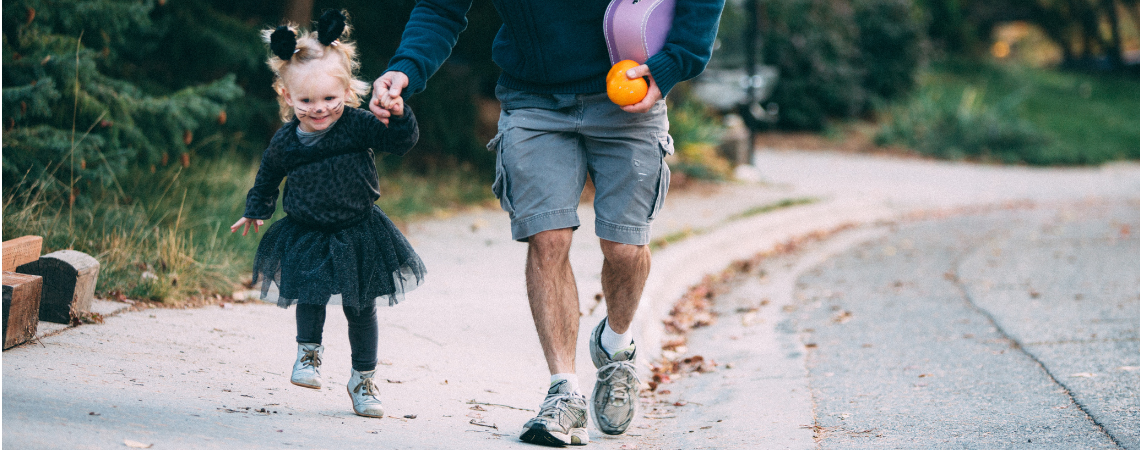
Walking the neighborhood burns energy. Plan for: a wagon, a buddy’s hand, and short stretches. |
A glow-stick dance party or a backyard hunt. Plan for: a play space with room to move. |
| Tires out by evening |
An early, daylight loop fits before the tired hour. Plan for: a wagon or stroller. |
Pajamas can be the costume. Plan for: an early start and an easy bedtime. |
A little of both works, too. Visit three houses before dinner, then head home to hand out treats. If siblings want a longer night, one grown-up can take them while your child enjoys a night in.
If a night in sounds right, our guide to Halloween sensory activities at home has ideas for sensory bins, pretend trick-or-treat, and more.
Planning to go out on Halloween
If your child is ready for the neighborhood, these steps help the night feel familiar and fun.
Brothers and sisters get a say, too. Lean into the part of Halloween they might be interested in, by planning a piece of the night that’s just for them, like a few extra houses with another grown-up.
Choose a costume your child is excited to wear
The best sensory-friendly Halloween costumes start with what your child loves: a favorite animal, character, color, or truck. A costume built around something they care about is one they are more likely to want to wear.
Then think about how it feels. Soar’s occupational therapists help children build the strength and independence to get dressed and to feel comfortable in everyday situations. The same thinking helps here:
-
- Soft, familiar fabrics. Cotton and fleece are easier for many children than polyester, tulle, sequins, or stiff felt.
-
- No tags and flat seams. Cut out tags and run your hand along the inside seams.
-
- Loose at the neck, wrists, and waist, with a front zipper or hook-and-loop closure so it comes off fast.
-
- No masks. Masks can feel hard to breathe in and change how things look and sound. A hood with ears or a hat is a gentler choice.
-
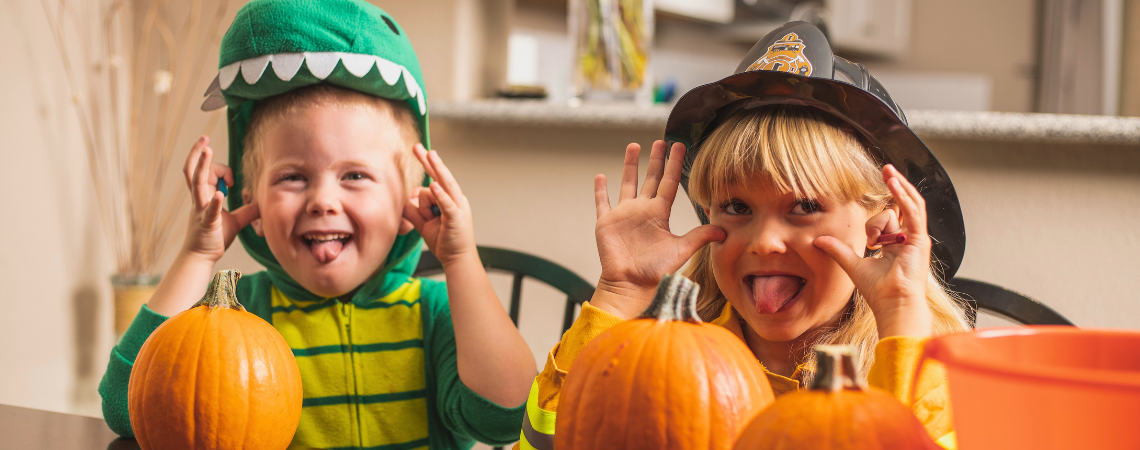
- Build on clothes they already love. A favorite hoodie plus felt spikes becomes a dinosaur. A character T-shirt counts as a costume.
-
- Opt for PJs. Many major stores sell themed pajama sets. These can often feel similar to known clothing and are made with soft materials and to move with littles as they sleep. These can be both a sensory and budget-friendly option.
-
- Look at adaptive options. Some stores sell adaptive Halloween costumes with soft fabrics, easy openings, and room for wheelchairs or other equipment if needed.
Purchasing the costume ahead of time can allow for your child to get excited and used to their costume, but don’t stress the need to wear the costume before Halloween. If they want to play in it during the week, great. If one piece bothers them, leave it off. A dinosaur without a tail is still a dinosaur. And, if they decide to forego the costume the evening of, be flexible and let them choose what to do, it’s their night!
Pick a bucket and a way to join in
There is no script your child has to follow at the door. Holding up the bucket, waving, smiling, pointing, or simply taking a treat are all acceptable forms of communication at the door. So is staying on the sidewalk and watching.
-
- A blue bucket, if you want neighbors who know the signal to have a heads-up.
-
- Any bucket they love, if you would rather not signal anything.
-
- A bucket with a picture board. Augmentative and alternative communication (AAC) means tools and devices that give a child a reliable way to communicate, in their own voice. If your child uses an AAC device, bring it. You can also make a simple trick-or-treat AAC board by taping printed picture symbols, like “trick or treat,” “thank you,” and “Happy Halloween,” right onto the bucket. Practice at home and with your child’s SLP so it feels like a fun game.
Your countdown to Halloween night
Soar’s therapists teach through joint activity routines: short, playful routines a child and a grown-up repeat until each step feels easy. A little playful practice before Halloween works the same way.
Two weeks before
-
- Choose the costume together. Offer two or three ideas built around what your child loves.
-
- Pick your bucket and how your child might like to join in.
-
- Start noticing which decorations in your neighborhood are loud, flashing, or move suddenly.
The week before
-
- Play doorbell. Stand outside a bedroom door with a bucket. Your child knocks, you open the door and hand over a treat. Take turns being the one at the door, and keep it short and fun.
-
- Walk the route in daylight. Point out the houses you will visit and the decorations that might surprise your child.
-
- Make a visual schedule of the night. Line up a few photos or drawings in order, like costume, walk, knock, treat, and home, so your child can see what comes next and when the night ends. Phone photos of your own front door and street work great.
-
- Practice the “all done” signal. Practice a word, a sign, a signal or a card your child can use when they are ready to go home.
Halloween day
-
- Keep the day quiet, with a nap if your child still takes one.
-
- Eat an early dinner, so hunger is not part of the evening.
-
- Head out before dark, when streets are quieter and decorations are easier to see.
-
- Help ease transitions through communication. Your child may not have the words for each situation or what comes next, and that’s ok. You can help set expectations and ease transitions by naturally narrating the moment:
-
- “Knock, knock! Candy!”
-
- “Bye, house! Next one?”
-
- “Ooh, a pumpkin!”
-
- Help ease transitions through communication. Your child may not have the words for each situation or what comes next, and that’s ok. You can help set expectations and ease transitions by naturally narrating the moment:
-
- Celebrate every way your child joins in. Whether that’s a wave, a point, a sound, or a smile. Avoid prompting communication, like “Say trick or treat” or “Say thank you.” They’re taking part in their own way and will communicate when ready.
The next morning
-
- Talk about the best part, using the visual schedule or photos from the night.
-
- Keep the day low-key, and follow the candy plan you picked.
Reading your child’s signals
Watch your child, not the clock. Children often show they are becoming overwhelmed well before the night gets hard.
Early signs of becoming overwhelmed, overstimulated, or overtired:
-
- Going quiet
-
- Holding your hand tighter
-
- Covering ears
-
- Chewing on a costume or sleeve
-
- Walking faster and faster
Ways to help before it builds:
-
- Plan breaks before you need them. Pause every few houses on a quiet corner or in the wagon.
-
- Offer simple choices. “This house or that one?” “Wagon or walk?”
-
- Bring comfort from home, like headphones, a favorite toy, or a snack they know.
-
- Skip the loud houses. Walk past big displays without stopping.
-
- Let them watch. Your child can stay on the sidewalk while a sibling goes to the door.
Signs it’s time to go home now:
-
- Your child uses their “all done” signal
-
- They don’t seem as engaged
-
- You’ve reached the end of your planned route.
Ending while the night still feels good keeps the best parts front and center.
Your going-out checklist
☐ A costume your child picked, plus a comfortable layer underneath
☐ Noise-reducing headphones if your child uses them
☐ A familiar snack and water
☐ A flashlight or glow stick so dark streets feel less strange
☐ A wagon or stroller for a tired child
☐ The visual schedule and the “all done” signal your child practiced
☐ Your bucket choice and a candy plan
☐ A short route with an easy way home
☐ Boundary-holding phrases to use with neighbors, family, friends, and other trick or treaters:
-
- “We’re taking our time tonight. Is it OK if we choose a treat we enjoy?”
-
- “We’re going to skip this one. Happy Halloween!”
-
- “We’re doing three houses this year, and that’s a great night for us.”
-
- “We’re staying in this year, and we have a fun night planned.”
-
- “We had fun, and we’re heading home.”
If going out is not for you
A night at home can be just as fun, and your child sets the pace. They can help hand out treats, knock on bedroom-door “houses” for a pretend trick-or-treat, dig into a Halloween sensory bin, or curl up for a movie night.
If you are the one at the door, the simplest thing welcomes every child: smile, offer the bowl, and don’t wait for the words. A wave, a nod, or a quiet smile is a perfectly good trick-or-treat.
Want help with the hard parts of everyday routines, not just Halloween? If clothing, sounds, or crowds make ordinary days tough for your child, our care team can talk through what support could look like. Schedule a call
FAQs
What does a blue bucket on Halloween mean?
A blue bucket is meant to signal that a child has autism and may not say “trick or treat” or “thank you.” The idea spread from a parent’s social media post in 2018 and is not an official program. Some families find it helpful. Many adults on the spectrum and autism advocates worry that it labels children in public. Whether to use one is your family’s choice.
What do the colors of Halloween buckets and pumpkins mean?
Two colors have become common signals. A blue bucket is meant to show that a child has autism and may not speak at the door. A teal pumpkin on a porch means the house offers non-food treats, from the Teal Pumpkin Project run by Food Allergy Research & Education (FARE). Neither is required, and children are welcome at the door with any bucket.
Do kids with autism like Halloween?
Many do. Some children with autism love costumes, pumpkins, and candy but find doorbells, crowds, or masks hard. Adjusting the hard parts, like a soft costume, a short route before dark, or a fun night at home, lets your child enjoy the parts they like.
What if my child won't wear a costume?
That’s OK. Let your child wear one piece they like, such as a hat, ears, or a character T-shirt, themed pajamas, or skip the costume entirely. Regular clothes or pajamas are a perfectly good way to celebrate.